Key Field Takeaways
- Save 3–5 swarmers or shed wings inside a sealed zip bag for free species verification by Certified Applicator Charles Lehnhoff (CA#785150).
- Inspect bathroom plumbing chases, AC condensate drain pans, recessed lights, and exterior slab expansion joints for moisture and mud tubing.
- Formosan colonies hold millions of workers and can construct above-ground aerial carton nests inside damp walls—repellent sprays only scatter satellites deeper into rooms.
1. Swarmers Outside vs. An Active Structural Colony Inside
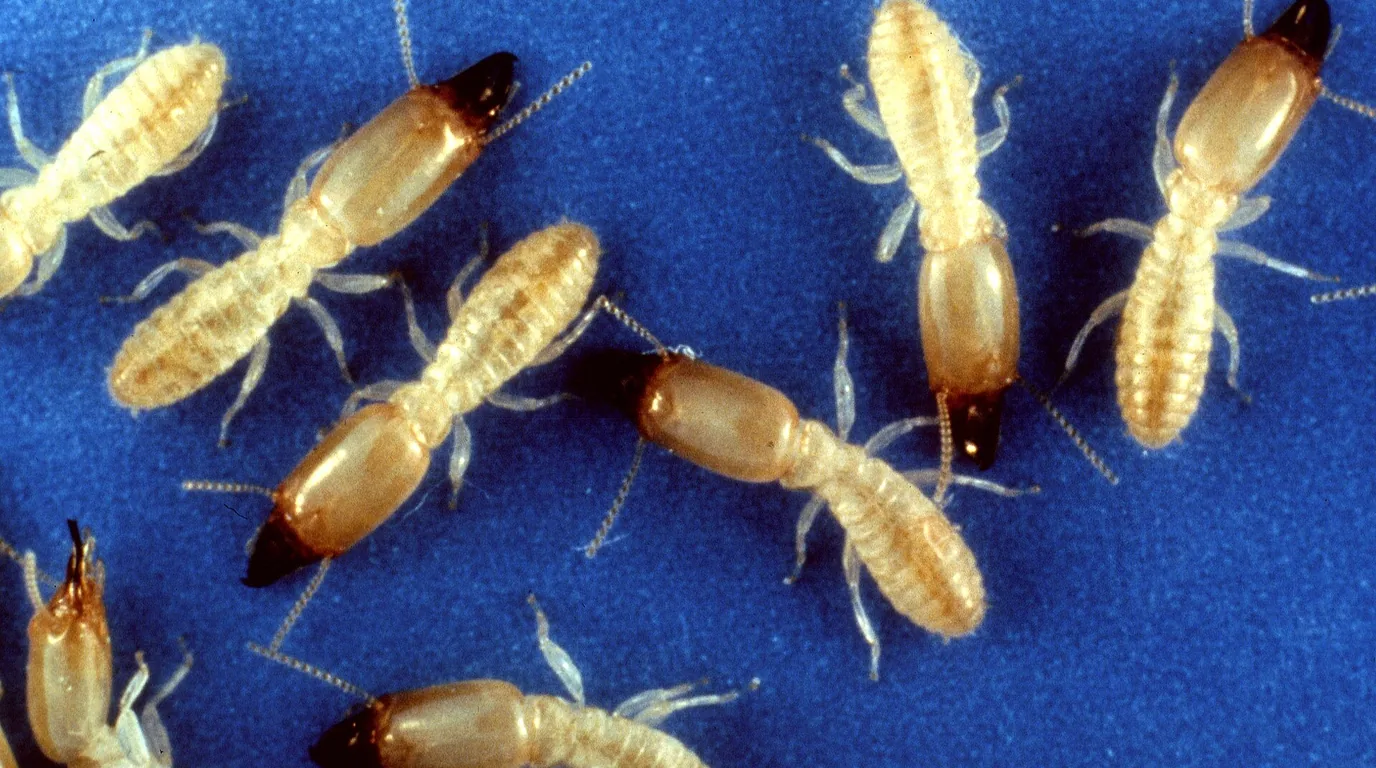
Every warm, muggy evening between late April and June across Texas City, League City, Clear Lake, Kemah, and Galveston Island, Formosan subterranean termites (Coptotermes formosanus) launch dusk dispersal flights. Because Formosan alates are strongly attracted to bright LED porch lights and living-room TV glow, finding dozens of insects around an open sliding patio door or garage apron after a thunderstorm does not automatically prove they erupted inside your walls.
On the other hand, finding piles of uniform translucent wings on a closed bedroom windowsill, emerging out of tiny paint blisters along drywall, or fluttering inside a shower fan housing demands an immediate structural moisture and sounding inspection. Along the Gulf Coast's heavy clay soils and high humidity, Formosan colonies feed far faster than native Eastern subterranean species because a single mature colony can exceed several million foraging workers.
2. Why DIY Aerosol Sprays Backfire on Formosan Colonies
When swarmers squeeze out through a pinhole beside a bathroom vanity or window trim, the first instinct for many homeowners is to flood the gap with household bleach, wasp spray, or pyrethroid bug bombs. That mistake often turns a treatable localized breach into a wider repair bill.
Critical First-24-Hour Mistake to Avoid
Repellent aerosols kill a handful of visible swarmers at the exit slot while alerting foraging workers to seal off that gallery and relocate down adjacent framing studs—and worse, spray residues contaminate injection sites needed for non-repellent transfer treatments.
Instead, vacuum spilled wings quietly, put a strip of painter's tape beside the exact pinhole or blistered drywall seam so our inspector can locate the emergence channel immediately, turn off unnecessary exterior floodlights until swarm activity peaks and fades (usually 90 minutes after dusk), and save a few intact bodies in a zip bag.
3. Immediate 4-Step Homeowner Checklist While Waiting for Inspection
- 1 Identify vs. Flying Ants: Termites show straight beaded antennae, uniform broad waistlines, and 4 equal-length fragile wings (compared to elbowed antennae and pinched waists on winged carpenter or fire ants). Text a close-up photo on white paper to (281) 896-0125 for same-day ID.
- 2 Check Conducive Moisture Points: Walk your exterior perimeter looking for mulch stacked higher than brick weep holes, leaking hose spigots, overflowing AC condensate pans in the attic, and wooden fence boards touching stucco or siding.
- 3 Leave Mud Tubes Unbroken: If you spot pencil-thick mud tubes along an interior garage stem wall or exterior concrete slab corner, take a photo first and leave at least part of the tube untouched so we can verify active foraging flow and moisture readings.
- 4 Deploy Non-Repellent Soil Barriers & Chitin Baits: Our TDA-licensed approach pairs sub-slab non-repellent trenching or bath-trap targeted treatments with locked in-ground chitin-inhibitor stations to collapse the entire underground colony rather than merely chasing swarmers away.
Need Same-Day Termite Identification or Slab Inspection?
Serving Texas City, League City, Clear Lake, Friendswood, and Galveston Island directly under TDA SPCS TPCL #0788300.
Field Authorship & State Compliance
Charles Lehnhoff • Certified Applicator (CA#785150)
Imperium Pest Solutions / Sphaerus LLC (TPCL #0788300) • 617 8th Ave N, Texas City, TX 77590 • Direct Dispatch: (281) 896-0125.